Right-sizing · the Bates method
The right model. For the computer you own.
Bigger is not the starting point. Pyrinas.co sizes the AI to the work and to the hardware, then lets it grow only when the evidence says so. Here is the whole process, step by step, on a 2013 Mac Pro.
Reuse.Benchmark.Specialize.Escalate.
- The default. Every request leaves your computer for the largest model. Your machine sits idle.
- Reuse. 2013 Mac Pro · 6 cores / 12 threads · 60 GB memory · 2 × 3 GB graphics · no modern AI acceleration.
- Benchmark. 1.2B clears 3 of 10 tasks · 7.6B clears 6 of 10 · 8.3B clears 10 of 10 · 20B+ adds none.
- Specialize. 8.3B Liquid model · 4.70 GiB file · ~7.88 GiB working memory · about 13% of this machine · runs on the CPU alone · nothing metered.
- Escalate. Scenario: 90% of routine tasks stay local · 0.1086 Wh per routed task vs 0.34 Wh centralized reference.
Every question goes to the biggest model.
The enterprise AI market often treats model size as a proxy for capability. So every request leaves your computer for a data-center model, whether or not the task needs one, and the machine on your desk sits idle.
Start with the computer you already own.
Our lab machine is a 2013 Mac Pro: six cores, 60 GB of memory, two 3 GB graphics cards and no modern AI acceleration. Right-sizing reads what is there before anyone buys anything.
Bates: “the machine should not be discarded solely because the model will not fit.”
Measure the work. Then size the AI.
The Bates benchmark ran ten enterprise tasks across models from 1.2B to 108.6B parameters, with an 80/100 quality gate. A 1.2B model cleared three tasks. A 7.6B specialist cleared six. An 8.3B model cleared all ten. No 20B, 30B or 100B-class model was needed.
The right-size model moves in.
The largest winner, an 8.3B Liquid model, is a 4.70 GiB file that needs about 7.88 GiB of working memory. On our 2013 Mac Pro that is about 13% of the machine, and it runs on the CPU alone. Smaller jobs get smaller models: three run side by side for Agentopia.
Go bigger only when the evidence says so.
“Escalation is a feature.” Begin with the least costly trustworthy capability and escalate when quality, risk, context, or evidence requires more. Measured: 0.1086 Wh per routed task, against a 0.34 Wh centralized reference.
Benchmark figures: Bates Enterprise AI Efficiency Benchmark, Public Research Edition v1.0 (August 2026), measured on an NVIDIA RTX 3090 Ti host. Lab figures: our own 2013 Mac Pro, measured on its CPU. Ring sizes are drawn in proportion to parameter count. None of this is an Edgar performance guarantee; Edgar’s supported computers and minimum requirements are still being validated.
Research snapshot
Parameter count did not predict useful enterprise work.
In the measured task-routing phase, the lowest-energy passing model for each evaluated task was a local compact or specialist model. The task-optimal winners were 8.3B parameters or smaller, despite the broader test set extending to 108.6B nominal parameters.
View as table
| Maximum model tier allowed | Cumulative task coverage |
|---|---|
| 1.2B | 3 of 10 tasks |
| 7.6B | 6 of 10 tasks |
| 8.3B | 10 of 10 tasks |
| 20B+ | No additional task was required to obtain the lowest-energy passing route |
How much room the winners need
| Representative model class | Observed quantized weight file | Conservative modeled practical memory |
|---|---|---|
| 1.2B Q4 | ~0.68 GiB | ~2.85 GiB |
| 7.6B Q4 specialist | ~4.36 GiB | ~7.45 GiB |
| 8.3B Liquid MoE Q4 | ~4.70 GiB | ~7.88 GiB |
Scope note: These results are a measured research snapshot, not a claim that compact models universally outperform frontier systems. The quality gate is provisional, hardware and telemetry conditions matter, and some tasks legitimately justify heavyweight or external inference. The benchmark is designed to reveal where escalation is necessary - not to eliminate it. Source: Bates Enterprise AI Efficiency Benchmark and the public white paper.
Use the computing capital already manufactured
What you own may already be enough to start.
Under that conservative one-model-at-a-time memory model, a 16 GB legacy PC has enough memory capacity to hold the largest task-optimal model from this benchmark. That does not prove acceptable interactive latency on an old CPU. It means the machine should not be discarded solely because the model will not fit.
- Tier 1Legacy 16-32 GB CPU-only PCs
Potential batch/background or low-concurrency pilot candidates; interactive speed remains unmeasured.
- Tier 2Older 6-12 GB discrete GPUs
Strong memory-feasibility candidates for the tested compact winners; runtime compatibility and throughput must be measured.
- Tier 316-24 GB GPU workstations
Practical local inference tier; 24 GB RTX 3090 Ti was directly measured in this study.
- Tier 440+ TOPS NPU AI PCs
Useful emerging local tier for supported runtimes and small models; requires device-specific validation.
- Tier 5High-memory unified-memory workstations
Can host much larger local models; still should be justified by workload rather than capacity alone.
Hardware memory fit is necessary but insufficient; throughput, context length, runtime compatibility, thermals, and concurrency must be tested.
Escalation is a feature
Use the minimum system that reliably does the job.
The practical conclusion is not “always run small models.” It is “build an intelligence orchestration system.” A mature architecture should classify the task, determine the minimum required capability, select an appropriate execution tier, evaluate the result, and escalate when justified.
“An enterprise usually needs a better system before it needs a bigger model.”
- Deterministic softwareRules, calculations, validation, lookups, and transformations do not require generative reasoning.
- Compact/specialist local modelRoutine enterprise tasks can be performed reliably with low latency, lower energy, and stronger data locality.
- Larger local or departmental modelThe task needs more capability or context but still benefits from local control.
- Centralized/frontier modelComplex reasoning, advanced multimodal work, unusual context, burst capacity, or quality failure justifies escalation.
- Human expertRisk, uncertainty, policy, ethics, or business consequence exceeds the machine’s authority.
Proven on a 2013 Mac Pro
A computer most people would have recycled.
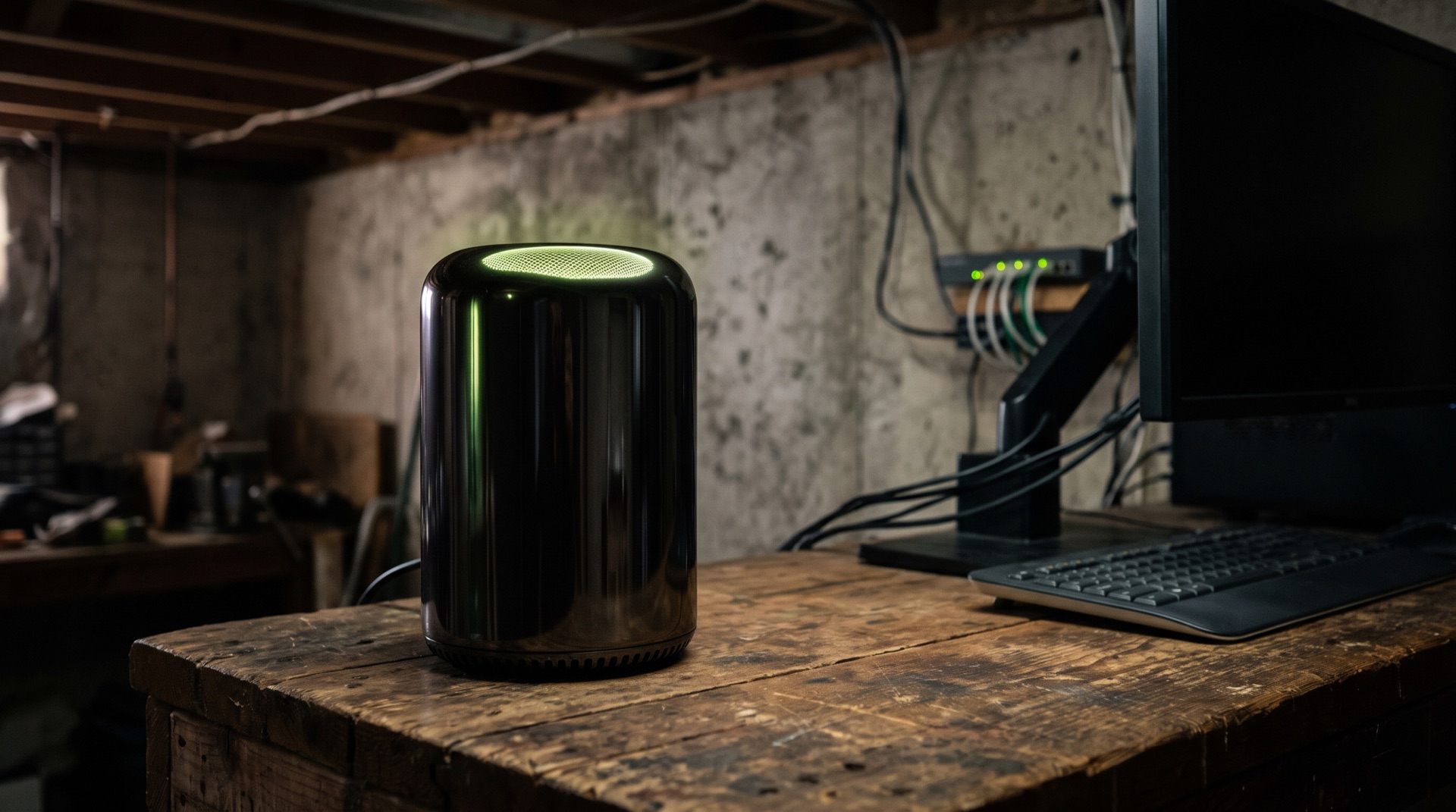
Local AI only matters if it runs on a real machine. Ours is the 2013 Mac Pro people call the trash can, with no modern AI acceleration. It runs Professor Bates’ Agentopia Detroit and TAi Local Studio, the local-first toolset that Edgar’s add-ons draw from.
Lab notes from our own right-sizing work, measured on our own hardware. They are not Edgar performance guarantees.
Why this page never says “tokens per second”
We don’t measure intelligence by how fast a machine talks.
Tokens per second, parameter counts, GPU counts, TOPS. The AI industry sells those measurements as if they were intelligence. Professor Bates calls it the gigahertz playbook all over again: a number that is easy to sell and does not tell you whether the work got done.
Edgar does not take part in that contest. There are no tokens to buy, nothing is metered, and your conversations never generate a usage bill, because the work happens on your own computer. Right-sizing asks a different question: what is the smallest, most efficient model that can reliably accomplish the task? Then it gets the job done.
Read the article: “The Biggest Threat to the Cloud AI Industry? People Discovering They Can Own Their Own Intelligence.” Professor Timothy E. Bates, LinkedIn, November 3, 2026.
“Own your intelligence. Don’t rent it.”
Local AI · thoughtful hardware use
More life from the hardware you own.
Put compatible existing computers to work, or choose a compact device suited to your needs. Match your local model to your hardware and the tasks that matter to you.
- A smaller model on suitable hardware can handle useful everyday tasks with less computation than a larger model.
- Model and hardware fit is on Edgar’s shared platform roadmap: local-first model routing, hardware right-sizing, and optional approved provider connections.
- Your Edgar license covers Edgar software only. AI models are downloaded separately by the user from third-party sources.
Requirements are still being validated. Capabilities and speed vary; equivalent performance to every larger cloud model is not promised. The Pyrinas.co benchmark is a general hardware assessment, not an Edgar compatibility guarantee or a purchase requirement.